
How My Quantum Computing Company Is Helping Solve Business Challenges Faster

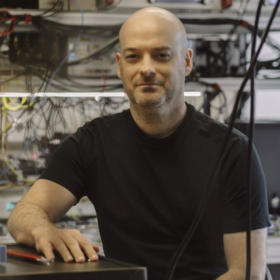
At 19, no one would’ve guessed I’d end up running a quantum computing company. I was in Australia at the time and had just failed my first year of film school—twice. I loved movies, but I was more into watching them than studying for the required humanities courses.
After dropping out of school, I decided to take four years to figure myself out. I read a lot, worked odd jobs, and tried to understand what truly mattered to me. I wound up producing TV commercials, stocking shelves at a supermarket at 4 A.M., and even tried a few small businesses like making heat packs–but nothing stuck. Eventually, I returned to the only thing I’d been good at in school: math.
When I returned to university, I started in pure math, moved into applied math, and gradually gravitated towards physics. By the time I completed my master’s, I was working on quantum security and quantum teleportation—subjects that sounded almost like science fiction. In 2005, I began my PhD in photonic quantum computing, using light instead of electrons to build quantum machines capable of processing information at speeds beyond the reach of classical computers. That work eventually took me from my home of Australia to MIT, and then the University of Toronto, where I continued as a postdoc.
By the end of my second postdoc, I faced a choice. The academic route meant applying for professorships and likely leaving Toronto—a city I’d come to love. At the same time, I could also see quantum computing startups gain traction, especially in the United States. In contrast, there was little activity in Toronto focusing on quantum computing and virtually none on quantum photonics.
I’d always been interested in entrepreneurship. At 14, I read Think and Grow Rich by Napoleon Hill—a classic self-improvement book that says anyone could succeed by following certain principles. I thought: “Why not me?” While I lacked the talent to create masterpieces Star Wars or Fleetwood Mac’s Rumours—two of my all-time favourite works–I believed I could build something from an idea using my strengths.
So in 2016, I founded Xanadu. At the start, it was just me and a whitepaper outlining the vision to build a quantum photonics company. Simply put, that means using light, or photons, to create quantum computers. Photons carry quantum information, or a qubit, at faster speeds with less energy than other dominant methods. This approach was still rare, with only one other company I knew of exploring it at the time, though with a different technical approach.
I chose photonics not only because it was my background but for its clear advantages: systems can operate at room temperature, avoiding the costly cryogenics required by other quantum systems. Photonics systems also use off-the-shelf components like lasers and fiber optics, avoiding the need to invent new hardware. Crucially, these systems can be connected like today’s data centres–a key step towards making them work at scale.
Our ultimate goal is to create a data-centre-scale quantum computer in Toronto that can solve real business problems. For now, we focus on “quantum readiness”–analyzing future use cases, co-developing patents, and preparing customers. We’re already generating single-digit millions in revenue and serving early customers, including major automakers.
We’re on track to complete a full quantum data centre by 2029 when the technology will be ready for practical applications. One key focus area is materials science—specifically, designing new batteries for electric vehicles. Current EV batteries last about 800 kilometres, but increasing that range by ten or a hundred times requires breakthroughs in chemistry. Classical computers can only approximate those problems, which is why drug and material discovery takes years and billions of dollars, with a 90 per cent failure rate. Quantum computers can change that, cutting time and cost dramatically, while upping the chances of success.
Still, knowing the potential didn’t make fundraising any easier. Deep tech requires massive capital and long product timelines. Early on, pitching quantum computing felt like Jeff Bezos explaining the internet on ’90s talk shows. Most people couldn’t grasp what it would become. In meetings with prospective investors, I spent most of the time just explaining what quantum computing even was. There was no real precedent for a company like this, and most investors understandably had little understanding of the field. Slowly, they began to see the potential—a turnaround I attribute to perseverance.
I’ll never forget the day the first $2 million from OMERS Ventures hit our bank account. I kept refreshing the screen to ensure it was real. In some ways, that moment was even more exciting than the $100 million rounds we’ve raised since. To date, we’ve raised about $250 million, backed by OMERS Ventures, Bessemer, Georgian, and others.
We’ve hit several other milestones along the way. In 2018, we published a paper in Nature–the gold standard of scientific journals–showing photonic qubits on a chip for the first time. Unlike classical bits–just 0s and 1s–a qubit can be both at once, thanks to quantum mechanics. That property lets quantum computers solve problems classical computers simply can’t. In 2019, our Borealis system demonstrated that power by solving a complex math problem in two minutes–something that would’ve taken the world’s fastest supercomputer seven million years to complete non-stop. That kind of leap highlights the real separation between quantum and classical computing known as quantum supremacy.
This year, we made two more breakthroughs. One showed how to connect four quantum server racks together–an important step towards building larger data centres. The other introduced a new way of building photonic qubits that are much more resistant to errors. Error correction and fault tolerance—ensuring the machine produces the right answer every time—are considered the holy grail of quantum computing. Quantum error correction is critical because quantum computing operates at an atomic scale, where it is prone to noise and errors. Classical computers faced similar problems early on, but over time, those errors became negligible. Quantum is at a similar stage, and we’re steadily making progress.
Building a company in such a specialized field comes down to the people. Our first 80 hires were almost all PhDs in quantum physics. Today, with about 240 team members–half Canadian and half international–we’re hiring more engineers and manufacturing specialists. That shift shows we’re moving from a science experiment to a real product. I believe in hiring not just brilliant minds but also those who embrace our culture by continuously learning and striving to build something great.
The applications of quantum computing may not be obvious to everyone yet, and it takes imagination to see where it’s headed. But just like the internet, once it’s here, it will reshape industries in ways we can’t fully predict. The technology won’t change the world overnight, but it’s set to be transformative.
Related: Toronto Start-up Cohere is Teaching Machines to Speak our Language
A quantum data centre will revolutionize fields ranging from drug discovery to artificial intelligence. Quantum simulations could dramatically reduce research and development timelines for new medicines, while also making EV batteries last much longer. Training AI models could require a fraction of the energy they do today. These are just a few examples of its potential impact.
When we finally open that quantum data centre in 2029, the first call I’ll make will be to my mom in Australia–assuming the time difference is reasonable. For years, she asked when I was going to “finish school.” That will be the moment I can say: this is what all those years were for.
– As told to Liza Agrba