
How I Launched Canada’s First Indigenous Woman-Founded Airline
I fell in love with flying during a trip to Botswana in 2001. I was on an aerial tour of the Okavango Delta, where the pilot banked the aircraft as he spoke about the land, and pointed out the trees, rivers, and animals below. It was an awe-inspiring experience that changed the course of my life. When the plane touched down, I knew I wanted to become a pilot.
Growing up in Quesnel, British Columbia, I didn’t have any clear vision of my future. It wasn’t until I had my first child at 23, that I started to think bigger about my life. I’m a Métis woman with Cree ancestry, and after my daughter was born, I reconnected with my Métis family in Fort Chipewyan, Alberta. With their support, I began to believe in myself and find my strength.
But becoming a pilot still felt like an improbable dream. At the time, I was a single mom with two kids and little education. I’d been working entry-level jobs and saving every penny to afford that trip to Africa, driven by my long-held wish to see its wildlife. Even so, I chose not to listen to the voice inside my head that said, “This just isn’t possible for someone like you.”
After returning to Canada, I started my flight training in Vancouver and, a year later, earned my commercial pilot’s license. I’m often asked how I managed to become a pilot so quickly given my circumstances–I had limited financial support, and was juggling multiple jobs. I borrowed money and accepted help from my community. I brought my kids to flight school, where they played inside while I logged flight hours in the air.
One of my favourite quotes is from Amelia Earhart, the aviator, who said, “You haven’t seen a tree until you’ve seen its shadow from the sky.” Flying gave me a much bigger perspective on everything—not just the landscape below, but my own life. I always say that getting my wings has given me wings for everything else.
Shortly after obtaining my pilot’s license, I completed a 50-hour float and bush plane course in Kelowna with Airhart Aviation. Recently, I reconnected with my instructor, who told me he vividly remembered us standing at the end of the dock in 2003 when I told him, “I’m going to have my own airplanes with my own logo on the tail.” I don’t remember saying this, but even then, I must have already been envisioning what would become my own airline, Iskwew Air.
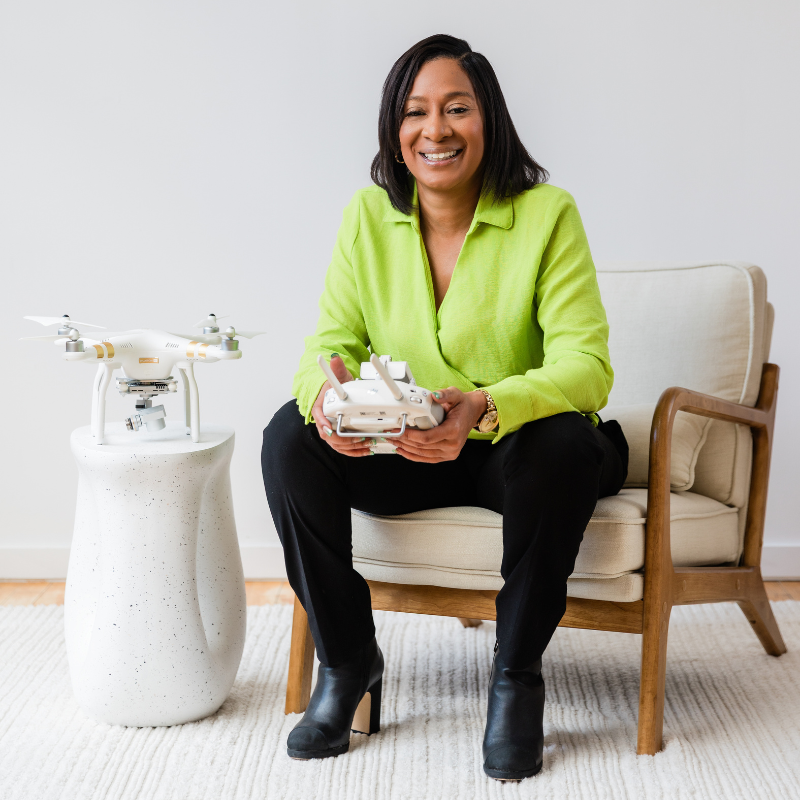
In 2006, after flying for a few regional airlines, I joined an aerial survey company in Vancouver that uses small aircraft to capture high-quality images for mapping or engineering purposes. I worked as both a pilot and in management. My partner at the time was a technical specialist there, and as we became increasingly drawn to digital technology over the older analog equipment in use, we decided to start our own business.
We launched Kîsik Aerial Survey in 2010, completing projects for various levels of government as well as mapping and engineering companies. I knew nothing about running a business so I had to figure everything out on the fly, from payroll to human resources.
I also began a master’s degree in leadership with Royal Roads University at the same time. It added to my workload, but it was fortuitous. I was learning about leadership daily and applying those lessons to building Kîsik Aerial Survey. Aviation is a technical industry, but it’s still about working with and leading people. The company taught me that leading with love is crucial for building trust and loyalty, and that a relational world view is key to long-term, sustainable success.
I brought these lessons with me to Iskwew Air, which I founded in 2018 after selling Kîsik Aerial Survey in 2016. I was tired and heartbroken, and thought it was time to leave aviation, so I held a letting-go ceremony to honour my career milestones and release them.
But I got stuck. I realized I would never get to have my own airline–a dream I wasn’t willing to let die. So my letting-go ceremony became a business ceremony. That same day, I named Iskwew Air, registered the domain, and incorporated the business online. It became the first and only Indigenous woman founded airline in Canada.
I began thinking seriously about launching an airline during the Vancouver Olympics in 2010. There was a desire for people from around the world to experience Indigenous stories and communities, but a clear barrier to connection. I believed an Indigenous-owned airline operating in B.C. could help bridge that gap.
Iskwew means “woman” in Cree. I chose the name as an act of reclamation—of womanhood, matriarchal leadership, and language. Aviation is a male-dominated industry, and Iskwew Air strives to support women within it. Our aircraft maintenance team is 80 per cent women, compared with just 2.3 per cent of aircraft maintenance engineers. Our flight crew also skews female, with four out of seven pilots (57 per cent) being women, compared with about six per cent of active pilots industry-wide.
Today, we fly three twin-engine, eight-passenger Piper Navajo airplanes. We operate daily scheduled service between Vancouver and Qualicum Beach. We also fly charters, and deliver cargo.
Reciprocity is one of our core values—I want to honour the original stewards of the land, while treading softly on Mother Earth. Iskwew Air is a founding partner in the Canadian Advanced Air Mobility consortium, advancing research and development for zero-emission aircraft.
I knew that starting an airline would be hard, but I never imagined how hard it would be to do so during a global pandemic, with few people flying, and constantly changing regulations. Through sheer tenacity, we persevered and continue to grow. Our revenue in 2020 was just $53,000, but we closed at $1.5 million by 2025. When we began passenger service in 2021, we carried just 480 passengers. By 2025, that number grew to 5,837.
Related: How I Launched a Luggage Brand During the Pandemic
But more meaningful to me than the numbers are the small ways Iskwew Air is making a difference. One passenger wrote us a beautiful poem. A Métis Air Canada pilot told me that every time he hears our call sign when he’s flying in or out of Vancouver, he shares our story. An Indigenous woman wrote to say that she never thought she could do something like this until she saw me doing it. That impact extends to Give Them Wings, a non-profit I founded in 2019 that inspires Indigenous youth through the wonder of flight and encourages them to pursue aviation, as I did.
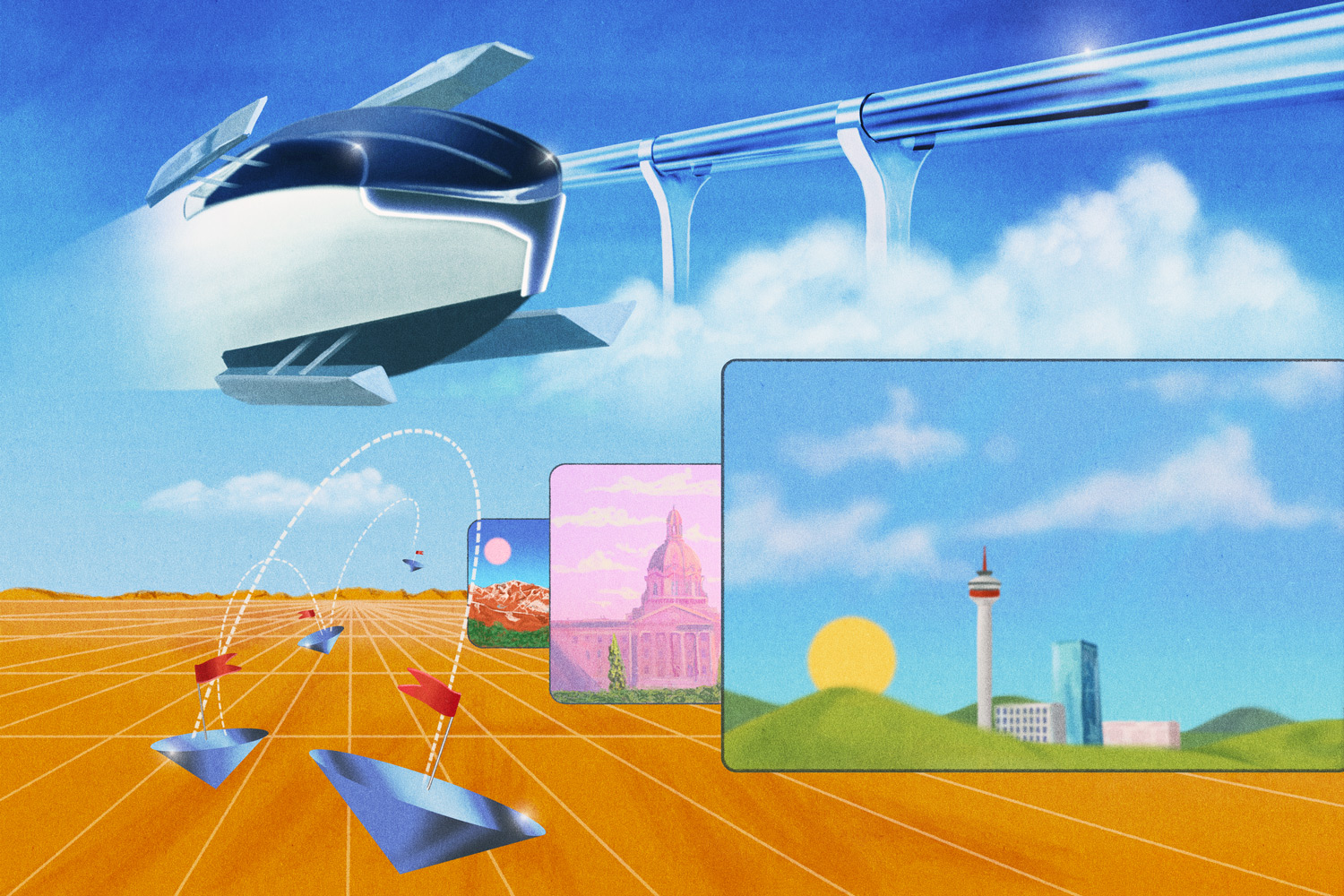
Looking ahead, I see a bright future for Iskwew Air. We already have an established route, a loyal customer base, and healthy revenues. I see our team doubling the fleet, building a northern hub, and adding regional aircraft. I’d also like to launch an electric aircraft maintenance innovation hub, and enter the market with sustainable eVTOLs— electric aircraft that take off and land like helicopters. I envision a future where flying is more innovative and sustainable, with less impact on the planet.
– As told to Lisa Kadane