

What’s the Value of Internships in a Post-Covid Workplace?

In 2020, more than half of the internships in the U.S. were cancelled, according to a Glassdoor estimate. Expecting an economic downturn, employers cited safety and budget concerns. Now that we’re through peak pandemic times and many companies have reinstated internships, how have these programs changed? Are there still benefits to student internships, and are they worth it—for both employers and interns?
Sarah Tatsis, former BlackBerry intern and its current SVP of IVY platform development, and Ana Rita Morais, chair of George Brown College’s School of Design and creator of the database Pay Design Interns, weigh in on what employers should know about designing a modern internship program.

ANA RITA MORAIS: At companies that kept or have reinstated their internship programs, I’m seeing a paradigm shift: Employers generally have much higher expectations of interns than they did pre-pandemic. With the increase in hybrid and remote work, it’s more difficult to onboard and train people virtually, so employers want someone who is more mature and has strong communication skills.
SARAH TATSIS: One thing that suffers in remote environments is the ability for students to learn about roles besides the one they were hired to do. Being back in person and seeing the day to day means interns can make more informed decisions about their futures.
A.R.M.: Just like before the pandemic, internships are an opportunity to network, understand structures and frameworks in places of work and learn how to collaborate and engage with colleagues. And from an employer’s perspective, training the next generation of talent and drawing on their experiences is a tremendous way to add value to the organization.

S.T.: Exactly. Bringing in fresh perspectives generates innovation and creativity—and that’s really what we’re after when designing new products and services. We’re also continuing to see increased productivity as a result of internship programs because we are able to give interns day-to-day tasks that free up senior talent for higher-priority projects.
A.R.M.: More than ever before, given the cost of living, it’s crucial that employers pay their interns. When it comes to remote internships, there are already significant barriers to who gets to participate, since everything from technological access to the ability to focus and work well remotely depends on many factors. A lot of young folks don’t live alone—they live in distracting environments, so they may have to go out to work somewhere or rent office space, which is made more accessible with fair compensation.
S.T.: Empathy and flexibility are crucial. Not everyone can log in and work from nine to five, and we have to be ready to accommodate that. And, yes, BlackBerry’s co-op programs have always been paid. No matter what the economic outlook is, it’s still worth it for us to bring in co-op talent given the associated innovation and efficiency benefits.
A.R.M.: I also think mentorship is a huge factor. When you bring on an intern, you have to make sure they’re not just floundering in a cubicle (virtual or not). Go out for lunch with them once a week, set up a buddy system, talk about what’s working and what’s not working.
S.T.: Every one of our co-op students has a manager but also an onboarding buddy who helps them get up and going when they first join. It’s in the employer’s best interests to provide these things since it helps interns be productive.
A.R.M.: Ultimately, internships are about students exploring future career paths. A lot of people see getting hired right afterward as the measure of success for an internship. But success can appear in many different ways, even if that means learning that a particular company or way of working isn’t right for you.
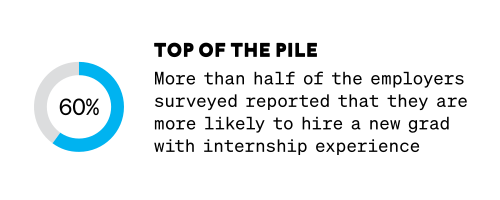
S.T.: When we’re making hiring decisions, we often look for people who have an internship on their resumé. On-the-job experience means they can hit the ground running as an employee. We need a lot of new talent in tech—to name one example, there are something like 3.5 million cybersecurity roles open globally. Internships are one of the best ways to get people into that job pipeline, so they are still extremely valuable in the current climate.