
Maria Qamar on How She Turned her Passion for Art Into a Sustainable Career
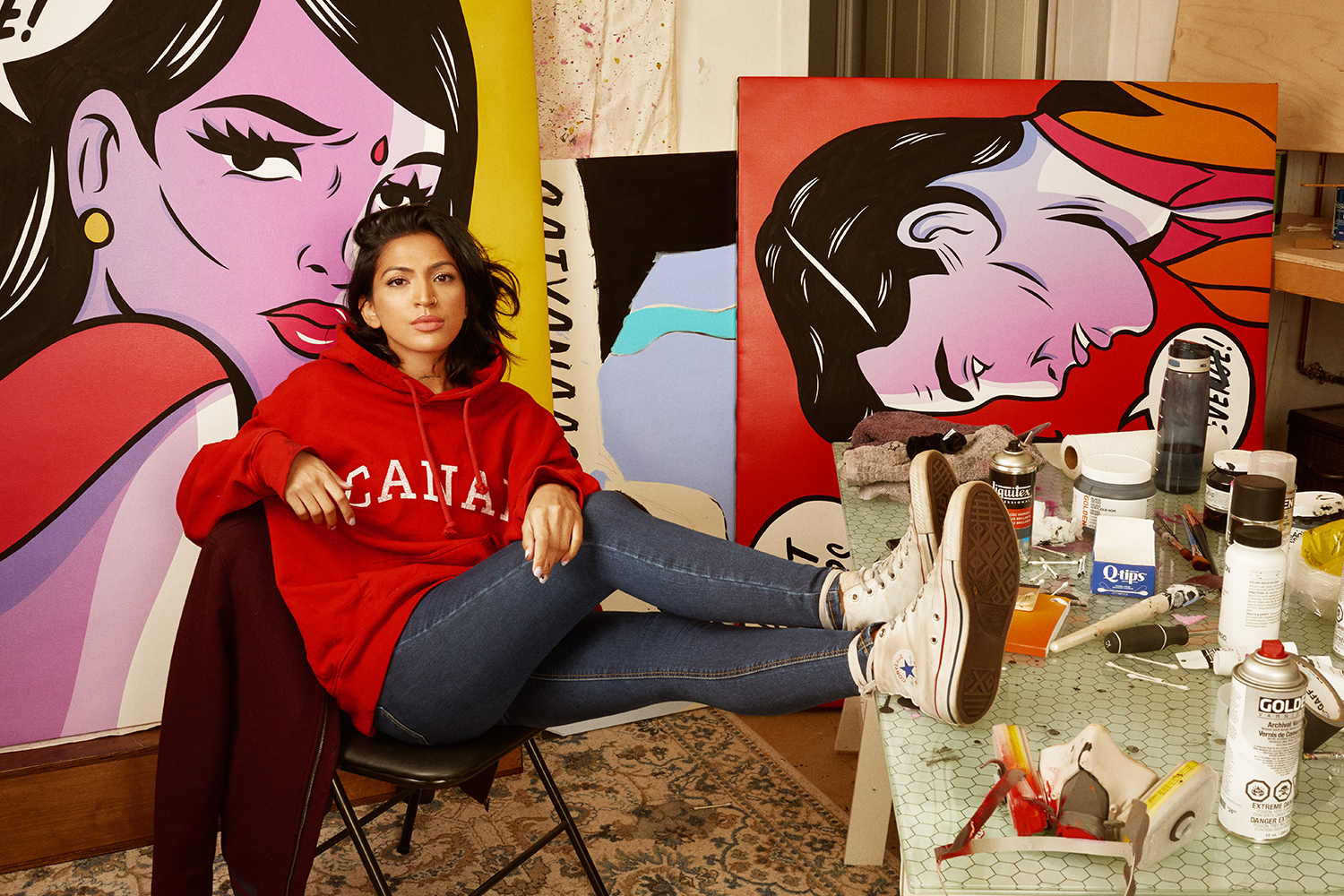
Toronto-based artist Maria Qamar started doodling during meetings while working as a copywriter. After posting her comic-book style illustrations of South Asian women on Instagram under the handle Hatecopy, she gained a following and attracted international attention. In March, the Museum of Contemporary Art Toronto announced its debut NFT collaboration with Qamar. Here, she tells CB how she made a career in art happen.
I have wanted to be an artist since I was three years old. Drawing was always the way I liked to communicate my ideas. I started taking it more seriously when I was enrolled in an art class as a kid and met this girl who was really good at drawing the genie from Aladdin. I got weirdly competitive about it—I wanted to be better than her at drawing the genie—so I went through a phase where I drew the character over and over again. My brother and I were also really into making comics together growing up. I think to some extent all kids are artists, and then it kind of fizzles out in adulthood. But I just kept on doing it.
Despite my passion for art, my parents—who are scientists—encouraged me and my brother to get into medicine. They wanted me to become a pharmacist, so in high school, they helped me get a gig shadowing one near where we lived in Mississauga, Ont. I lasted two weeks before I got fired. I was sorting out pills when I sliced my fingers with scissors and bled everywhere—including on the medicine. (My brother did end up becoming a doctor, though.)
Career-wise, in high school, I wanted to be an art director. It was my idea of a compromise, because it was creative but seemingly business-y enough for my family’s liking. But when I proposed it to my parents, they were not impressed because it still had “art” in the title. They wanted me to pick a career where I would be financially secure—and their idea of an artist was someone who becomes successful after they die. I settled on copywriting, because it was the closest I could get to something creative while convincing my parents I had a real job.
I landed my first copywriting gig in Toronto when I was 20, working on scripts for TV and radio, as well as billboards. I was really keen to get all my creativity out but quickly learned there were at least 30 people reviewing my ideas before anything got approved. During that time I would doodle during meetings: I made it look like I was taking notes but I was actually drawing the person in front of me, or myself with squiggly eyes. Sometimes I would post these drawings on my Instagram, under the username @hatecopy, which I chose because I didn’t want my co-workers to find me. My office was right beside George Brown College, so I would work until 7 p.m. then take an illustration class until 9 p.m. I saved up money to buy a Surface Pro tablet so I could draw on the screen and instantly upload my illustrations to Photoshop. After that, I found myself drawing at work all the time—or watching Youtube videos of cute dogs—until I got laid off in 2015.
I had enough money saved to float me for three months. I used my free time to draw and post my illustrations to Instagram. At first, I was just doodling women but eventually I developed a style akin to comic books where the protagonists were always South Asian women like me. The first comic I drew that really resonated with my friends and family was a woman in the style of a Roy Lichtenstein painting, saying “I burnt the rotis.” My friend sent me a message saying, “Dude, this is hilarious.” But after a few days of waking up at 3 p.m., I realized I really needed to get a “real” job. I started browsing LinkedIn every day for hours, applying to roles that didn’t even make sense for my experience, like the head of a fashion company in Germany. I was racing against the clock until money ran out.
Instead of finding full-time work, I started taking on copywriting contracts with agencies while continuing to draw. My Instagram following grew and I started getting international attention for my work: I was profiled by the BBC and Vogue India. In March 2016, I appeared on the cover of ELLE Canada magazine for my art alongside Wondagurl and Lilly Singh. My employer was like, “You’re on the cover of a magazine? What are you doing here? Go pursue that.”
At that point, I realized I could use my skills to build my own brand. I started posting my artwork regularly on Instagram and took every opportunity, like showing my work at coffee shops, that came my way. A lot of people reached out to me asking if they could buy prints of my work. I was still drawing in a sketchbook, so I decided to level up my sketches into paintings, take a photo of them, bring the photos to a printing shop and make posters for everyone who wanted one. There was enough demand that I made a website on Squarespace and started charging around $35 to $40 per poster. I sold quite a bit at first, which I didn’t expect.
I went to zine fairs and art markets with a stack of posters to sell. Then I got an offer to curate an exhibit at Soho House in Toronto. The fact that people were interested in my work really gave me the self-confidence to continue doing art as a job. My whole life, I was told that art wasn’t a valid career path, so it was really hard for me to gain the confidence that I could succeed in this.
In 2016, I got an email from someone who worked at the TV series, The Mindy Project, asking for some of my prints to hang in Mindy’s apartment on the show. At first I thought it was spam, but I Googled the person’s name, found their LinkedIn and it turned out they were legit. By the time I responded to the email, the person had already placed an order on my site. I ended up sending them a bunch of free stuff anyway.
After a few years of finding success as an independent artist, I was approached by a talent management agency after an interview I had done with the CBC on The National. Gaining representation allowed me to focus on doing art while having someone else run the business and e-commerce side, which allows me to make art a sustainable career.
Earlier this year, my solo exhibition, Dhamakedar, Superstar! opened at the Museum of Contemporary Art Toronto, or the MOCA. I painted a number of images of one woman who is obsessed with a pop star. One of the paintings, In Pyaar With a Superstar!, was also turned into a limited edition NFT. I never imagined I would have my own exhibition at the MOCA. I thought I would only end up at a museum after I was dead. But even though my career is going well and I definitely make more than I did as a copywriter, I still have this voice in the back of my mind telling me to get a “real” job.