
Why I Bet on a Better-For-You Gum Brand
I grew up an only child in Florida, raised by a single mom who ran a party gift business. She transformed people’s visions into beautifully decorated spaces with balloons and flowers—she loved making people happy. But from a young age, I also saw how hard it was to run a business. We didn’t take trips because she often worked on holidays and weekends. That upbringing taught me nothing would be handed to me. If I wanted to succeed, I’d have to earn it.
As a teenager, I dreamed of playing baseball at an American university. But in my senior year, I broke my elbow, and that dream quickly evaporated. In 1998, I moved to Toronto to study Political Science and Communication Studies at York University. My mom wanted me to avoid the stress of entrepreneurship and encouraged me to be a lawyer instead. But I wanted independence–the freedom to make my own decisions. So I made a deal with her: let me take a year and see what I can do.
When I finished university in 2002, I had $1,000. I used it to launch Drivertise, a marketing firm selling ads on cars. At first, I drove my own car around with other people’s ads on it, coldcalling businesses until I sold something. In my first year, I earned $37,000–enough to hire my first employee and cover expenses. I was determined to keep going.
Over the next few years, Drivertise continued to grow. I hired a small team, and began working with more businesses, including many fast-food franchises. We expanded into interior store design like menu boards and signage to shape the in-store experience, and I eventually sold the company in 2020.
But the idea for what came next actually started back in 2007 when we met with a client so focused on their own strategy that they weren’t really listening to our ideas. It made me wonder what it was like to sit on the other side of the table, making the decisions. So I challenged our team to create a product–chewing gum. Why gum? Because it’s something people share, and it’s always available in stores.
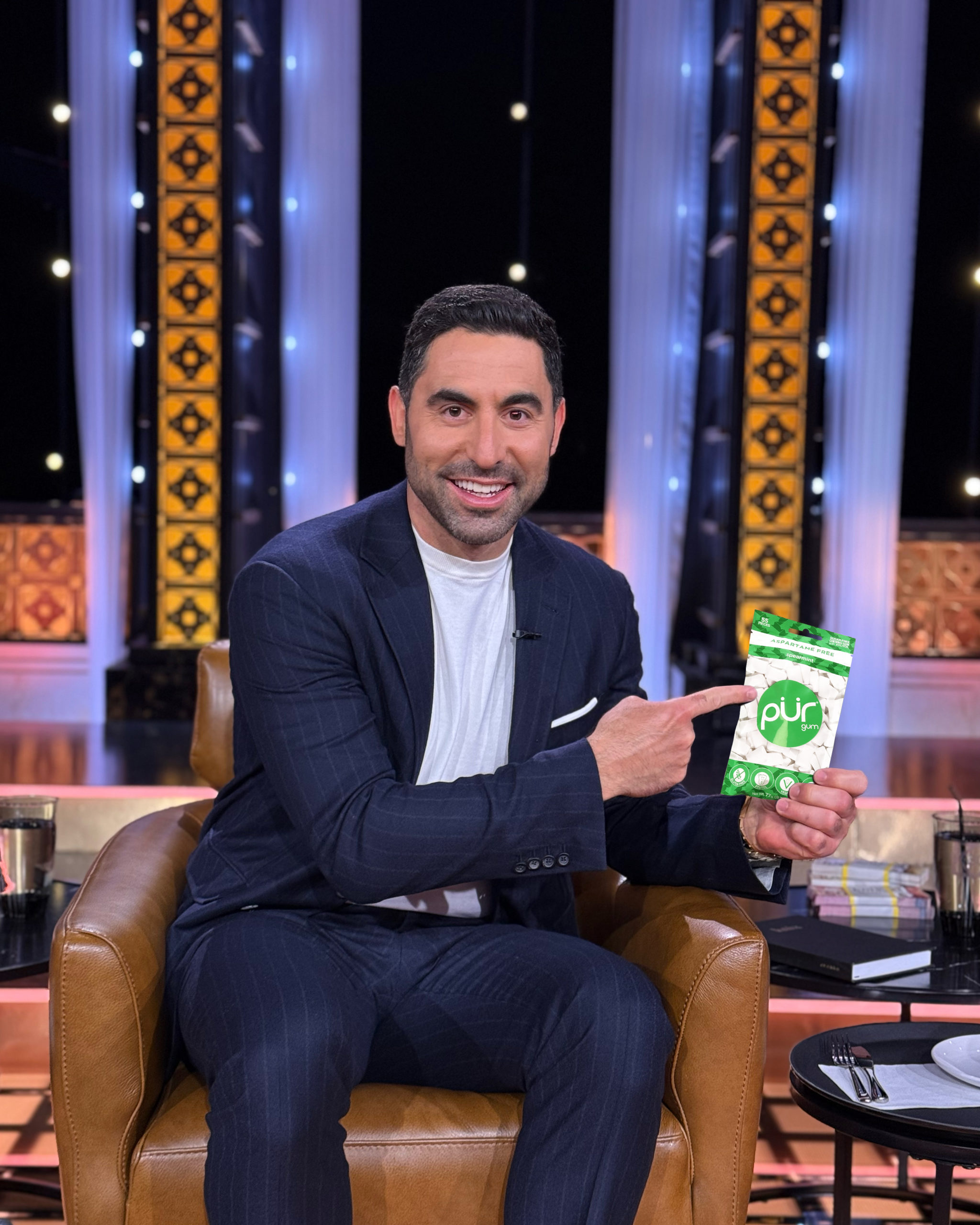
That experiment led me to PUR, the gum company I founded in 2010. When I shared it with friends and family, they told me not to do it because the industry was dominated by giants. I saw that as a good sign—if nobody was entering the market, maybe I should. To stand out, I focused on a healthier gum with no artificial ingredients, sweeteners, or colours.
Soon after, I went to a trade show in Europe, where I met someone who worked at a manufacturer. I told them I wanted to create a “better-for-you” gum. I had no background in consumer goods, but I was realistic about what I thought I could achieve, and they agreed to work with me. I ordered the gum and went through multiple rounds of taste testing. At the time, I couldn’t afford focus groups, so I’d walk up and down the aisles of airplanes and hand out gum to passengers. Some would decline, saying they chew gum. When I asked why, they’d say they avoided aspartame. But when I told them I was making aspartame-free gum, they suddenly wanted to try it.
From there, my goal was to sell one pack of gum to a stranger. I placed our first blister pack on a shelf in an independent health food store in the PATH, Toronto’s underground retail network, and waited. When somebody finally picked it up, I felt an incredible sense of accomplishment. But reality quickly sunk in—I had 750,000 more packs sitting in a warehouse. So I hired my first salesperson and focused on selling enough gum to earn back what we invested into production.
When we started selling gum to stores, it felt like campaigning for mayor. I had to shake hands and build relationships with store owners and sales associates. I couldn’t just talk about the product–I had to get them to try it. Within our first month of launching, May 2010, we sold to 33 stores and generated about $5,000 in revenue. By the end of that year, we’d sold to about 500 stores across Canada.
My strategy was to convert curiosity to consumption, so I focused on placing our products wherever consumers would naturally understand them. We focused on retail environments aligned with a health-oriented lifestyle—think moms with kids who have dietary sensitivities, or people who frequent yoga studios and smoothie bars. We wanted to meet them wherever they were.
In the early days, we made plenty of mistakes, from not proof-reading packaging to printing the wrong barcodes of flavours. But the school of hard knocks was a wonderful education to have, and we did everything we could to not repeat them. Our approach was to bring major league energy into a minor league ecosystem. We’d walk into independent retailers pretending we were servicing the biggest retailers in the world, bringing signage, counter displays and T-shirts, then return a few weeks later to check in. We did whatever we could to make retailers feel connected to the brand, which helped us build strong relationships.
For the first few years of PUR, it was just me and one other sales guy. I ate a lot of canned tomato sauce and pasta to stretch my dollars, putting everything back into the business. By year three, I started hiring a few sales reps. I didn’t know if it would work until 2014, when I was in my office refreshing sales numbers and saw we’d hit $10 million in revenue. At a dollar per unit, that was a lot of gum. We were seeing strong repeat orders, and I felt we’d built a solid foundation.
Once we’d earned that staying power, we expanded geographically–from Canada to the U.S., then the U.K., then Australia–saying yes to every opportunity. We also started selling online thanks to an intern’s idea. He said he could set it up for $49, so I told him to go ahead. Selling on Amazon made us available everywhere, and we’re now the number one selling chewing gum on the platform in the U.S., Canada, and five European countries. Today, PUR is available in over 50 countries. In the last year alone, we’ve sold over two billion pieces of gum.
Related: Canada’s Artisan Candy Companies Will Satisfy Your Sweet Tooth
We’re often asked how we compete with the conventional big brands. I’ve always believed in assembling the crumbs to make the cookie–building the business piece by piece. PUR is sold in small quantities all over the world that add up to a large business. If we had relied on a few large retailers—in other words, chasing the cookie instead of the crumbs—we likely wouldn’t have been this successful.
The genesis of PUR was small: could I sell one pack of gum to a stranger? Looking back, I think we succeeded, it was because we had many definitions of success along the way–never just one big north star. We just kept focusing on those small milestones.
– As told to Jadine Ngan