
Ben McKenzie’s New Book Is Coming for Crypto Bros

Ben McKenzie’s got a brand new bag. The actor, known for roles in TV shows The O.C., Southland and Gotham, has become a dedicated detractor of the crypto market, which he started exploring when his acting projects were on hold during the pandemic. While many of his Hollywood peers were touting Bitcoin and EthereumMax investments as guaranteed ways to grow wealth, McKenzie wasn’t convinced—it all sounded too easy.
The Brooklyn-based father of three might not seem like the obvious face of an anti-crypto crusade, but McKenzie’s background in economics (he studied at the University of Virginia) and ability to spot bad actors after two decades in show business made him wary of the unregulated market. He began sharing his concerns on podcasts and TV, and now he has a book, co-authored with journalist Jacob Silverman.
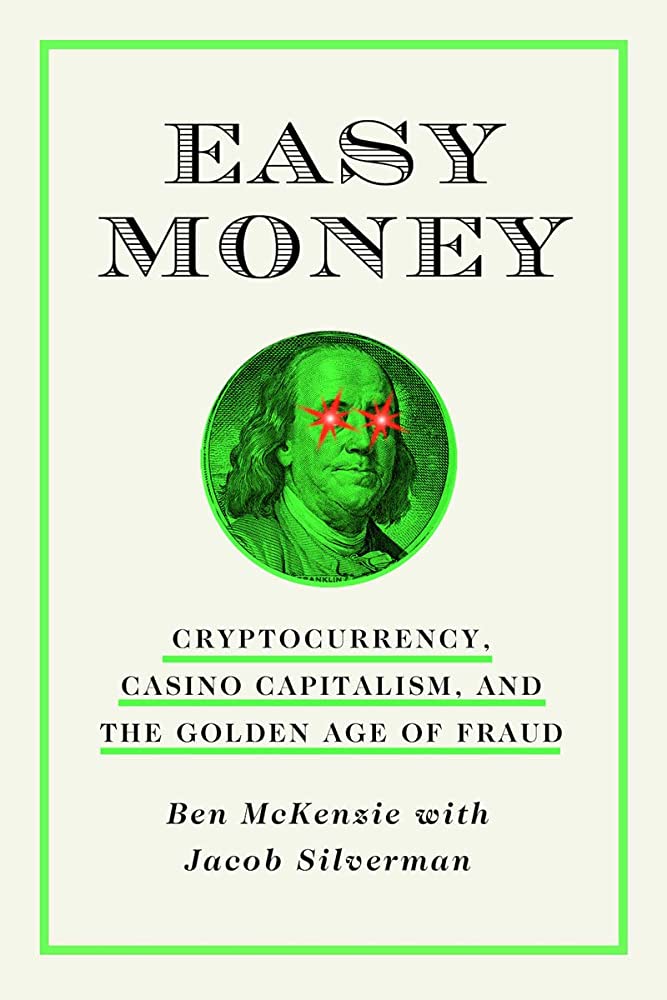
In Easy Money: Cryptocurrency, Casino Capitalism, and the Golden Age of Fraud, McKenzie travels to El Salvador—the first country where Bitcoin was made legal tender—interviews industry bigwigs, like FTX’s Sam Bankman-Fried, and speaks to a handful of the millions of people worldwide who saw their investments evaporate when the market crashed in 2022.
When you were researching crypto, what was the lightbulb moment when you realized things didn’t add up?
I kept running into problems trying to understand what it purported to be. There was all this over-the-top marketing from crypto companies about how these currencies were going to democratize and decentralize money. None of it seemed to make sense. I found the U.S. Securities and Exchange Commission website, which lists red flags for Ponzi schemes—like promising high returns with little risk. Crypto checks five, arguably six of the seven. Then I thought, “Oh, I’m not crazy.”
You could have just written off crypto as a scam and left it there. What made you feel you needed to ring the alarm?
These are unregulated, unlicensed investments. They’re being sold on unregulated, unlicensed exchanges. Some of them are guaranteeing above-market returns. And they were being marketed to the general public by some of the most famous people on the planet. There were no investor protections. It seemed to be a free-for-all. I felt like I had a duty to speak out.
Crypto currencies have disproportionately been bought by men, often younger ones. Why?
Statistically, young men are far more risk-tolerant than women. It’s one of the reasons they have a lower life expectancy—they tend to disproportionately make poor decisions, like drunk driving and gambling. So cryptocurrency—which has a lot of similarities to online gambling—appeals to their very nature. And then there is this libertarian escapist mindset: A lot of young men are attracted to the fantasy that you can be self-sovereign if you put all your money into crypto. You don’t need anyone—not banks, not the government. All you need is to master the code and you will have complete financial freedom.
Could the crypto bubble have inflated the way it did if it hadn’t been for the pandemic?
The easy money that started as a reaction to the subprime crisis had never really gone away. Then, in response to the pandemic, the Fed dumped US$5 trillion into the economy. The average American had a stimulus payment and unemployment insurance or PPP loans. They were stuck at home and isolated, and crypto—through which seemingly everyone was getting rich—was spreading through the internet and social media. The pandemic created the perfect groundswell for what is effectively the biggest Ponzi scheme in history.
You got a lot of big names to speak to you, including FTX founder Sam Bankman-Fried, who is now facing jail time for alleged fraud, and Alex Mashinsky, the co-founder and former CEO of Celsius Network, a crypto lending platform that has since gone bankrupt.
I was surprised that they were willing to talk to me on the record. I think it speaks to the ego that a lot of guys in crypto have. When things were going up, they felt like they were invincible. Alex and Sam have now both been indicted for fraud. They certainly knew what they were allegedly doing. That ability to rationalize and stick to the sales pitch—and to even seemingly believe in it—was quite remarkable to witness first-hand.
Related: The Fall of the House of Sharpe: What Exactly Happened to Bridging Finance?
You also call out stars, like Kim Kardashian, who promoted crypto on their social-media accounts. Do celebrities have a responsibility to do their own research before advertising investments?

They certainly have a moral or ethical obligation, I would argue, but they may even have a legal obligation. Shilling an unregistered, unlicensed security is against the law. Kim Kardashian is now paying a US$1.26 million fine for unlawfully touting EthereumMax. Hopefully it’s a lesson to others. But I’m somewhat skeptical that those lessons will stick. Celebrities will end up promoting some other financial product unless regulators are much more hands-on and proactive.
What, in your opinion, is the next bubble we should look out for?
Some of the same people that were in crypto have now gotten into AI. Sam Altman, CEO of OpenAI, has Worldcoin, which combines both—he’s out there scanning people’s irises and trying to prop up his coin. It’s the same sort of technoutopianism that fuels so many of these bubbles. I haven’t studied AI anywhere near as closely as crypto, but it’s not new. And while it is a technology that has the potential to transform a variety of industries, the hype is exaggerated compared to what we’re actually seeing. The marketing is boosting the stock prices, and it’s earning the executives of these AI companies a lot of money. Not that they’re committing any crimes. This is just the way these things work: You sell it, you sell it, you sell it.